Solana on KeeperHub: Two Triggers, Four Actions
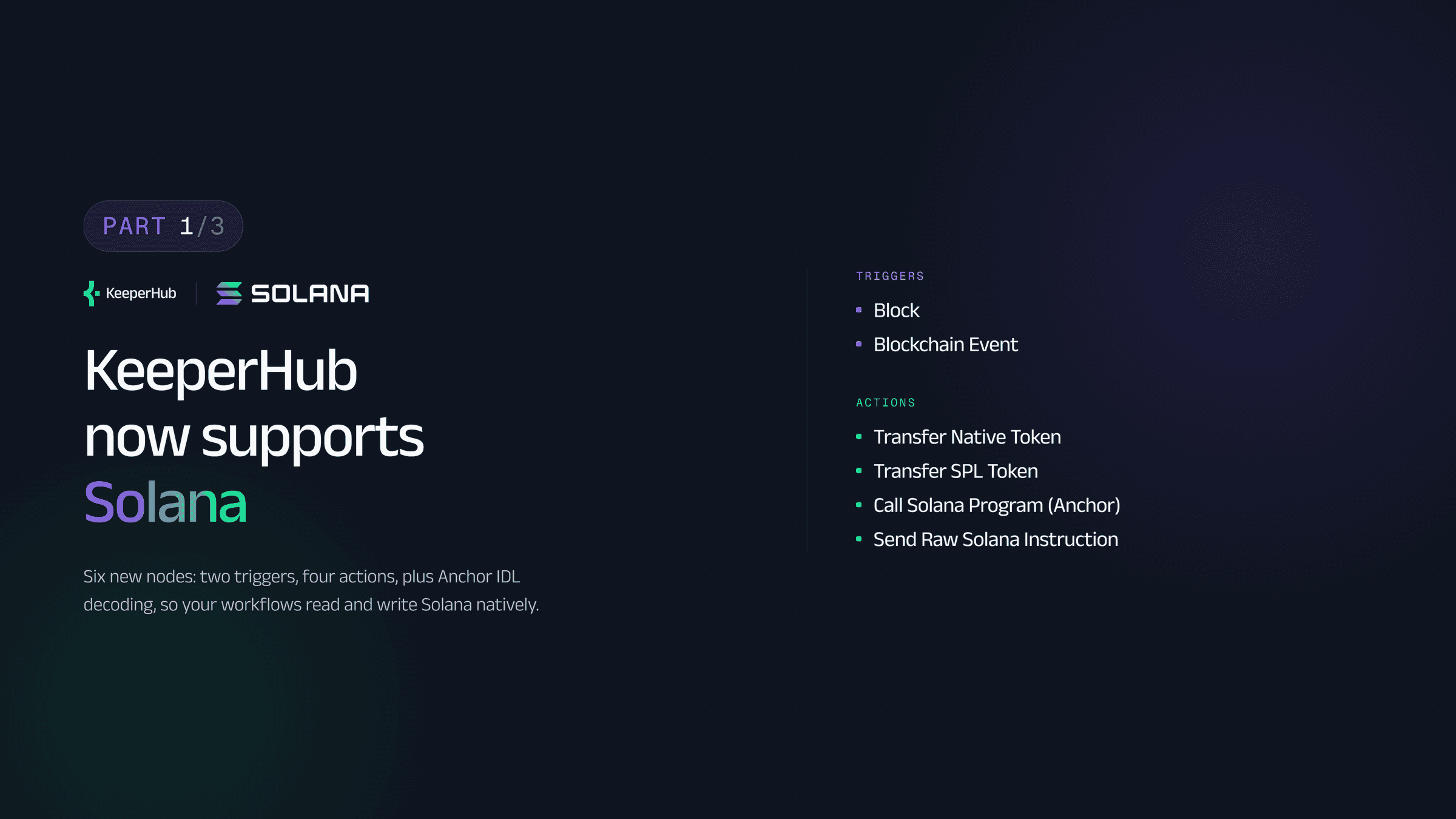
AI agents and automated systems can already decide what should happen on Solana. Executing it reliably, with spending limits enforced up front and an audit trail for every action, is the part that has been missing. KeeperHub now closes that gap: Solana support is live. Two trigger nodes can wake up a workflow, on a block interval or when a watched program emits an event, and four action nodes let it respond: send SOL, send an SPL token, call an Anchor instruction with typed arguments, or submit raw instruction bytes. Between the last two action nodes, any instruction that any Solana program accepts is reachable today.
We completed the build with AI code agents in less than two weeks, the payoff of years spent hardening the platform on EVM chains with a second chain family in mind from the start. This post covers what shipped.
What Our Initial Solana Integration Ships
Solana support ships as six nodes: two ways to wake a workflow up, four ways to make it act.
| Node | Type | What it does |
|---|---|---|
| Block | Trigger | Fires every N blocks on a Solana chain |
| Blockchain Event | Trigger | Fires when a watched program emits an event, decoded via its Anchor IDL |
| Transfer Native Token | Action | Sends SOL from the organization wallet |
| Transfer SPL Token | Action | Sends an SPL token, creating the recipient's token account if needed |
| Call Solana Program (Anchor) | Action | Calls a named instruction with typed arguments, encoded from the program's IDL |
| Send Raw Solana Instruction | Action | Submits arbitrary instructions: program ID, account list, raw data |
One existing node came along for free. Get Native Token Balance works on Solana too, since balance reads are part of the adapter interface and the node carries no chain-family filter.
Four actions is a deliberate floor, not a ceiling. Between the Anchor call and the raw instruction, anything a Solana program will accept is expressible today. What is missing is convenience: a node that knows what a Jupiter swap is, or a Marinade stake, or a Squads multisig proposal, and asks you for the three fields that matter instead of an IDL and an account map. Those are the next body of work. The general nodes exist so nobody has to wait for them.
What Is Next
Six nodes is a starting vocabulary, not a finished one. The general nodes exist so that nothing is unreachable; the work from here is making the common things easy rather than merely possible.
- Specialised action nodes for common Solana operations: stake and unstake, token account management, priority fee strategy. You should not be hand-assembling instructions for things everybody does.
- Protocol nodes, the Solana counterpart to the protocol coverage we maintain on EVM: named actions for the major Solana protocols, with the IDL and account derivation handled for you.
- Geyser ingestion by default on high-volume chains, so mainnet event triggers stay cheap as the number of watched programs grows.
- Endpoint re-resolution in the tracker, so a chain whose RPC configuration changes picks it up without a restart.
Common questions
Can I automate Solana transactions without running my own infrastructure?
Yes. KeeperHub supports Solana with two triggers (block-based and program-event) and four actions (SOL transfer, SPL token transfer, Anchor program call, raw instruction) — running on managed infrastructure with the same retries, monitoring, and audit trail as its EVM chains.
Does KeeperHub support Anchor programs?
Yes. Workflows can call Anchor programs directly, and for anything Anchor doesn't cover, the raw-instruction action lets a workflow send any instruction a Solana program accepts — a floor, not a ceiling.
How do AI agents automate Solana?
Agents connect through KeeperHub's MCP server and get Solana triggers and actions as native tools — the same agent-native surface (MCP, x402, MPP) KeeperHub exposes for EVM chains, now pointed at Solana programs.
Solana support is live for every organization today. Connect your agent to KeeperHub over MCP, or open the workflow builder, and point a workflow at Solana: get started.
This is part 1 of 3. Part 2: Why Now, and How We Built It in Two Weeks. Part 3, a full devnet tutorial covering every node above, is up next.