Agents decide, KeeperHub executes.
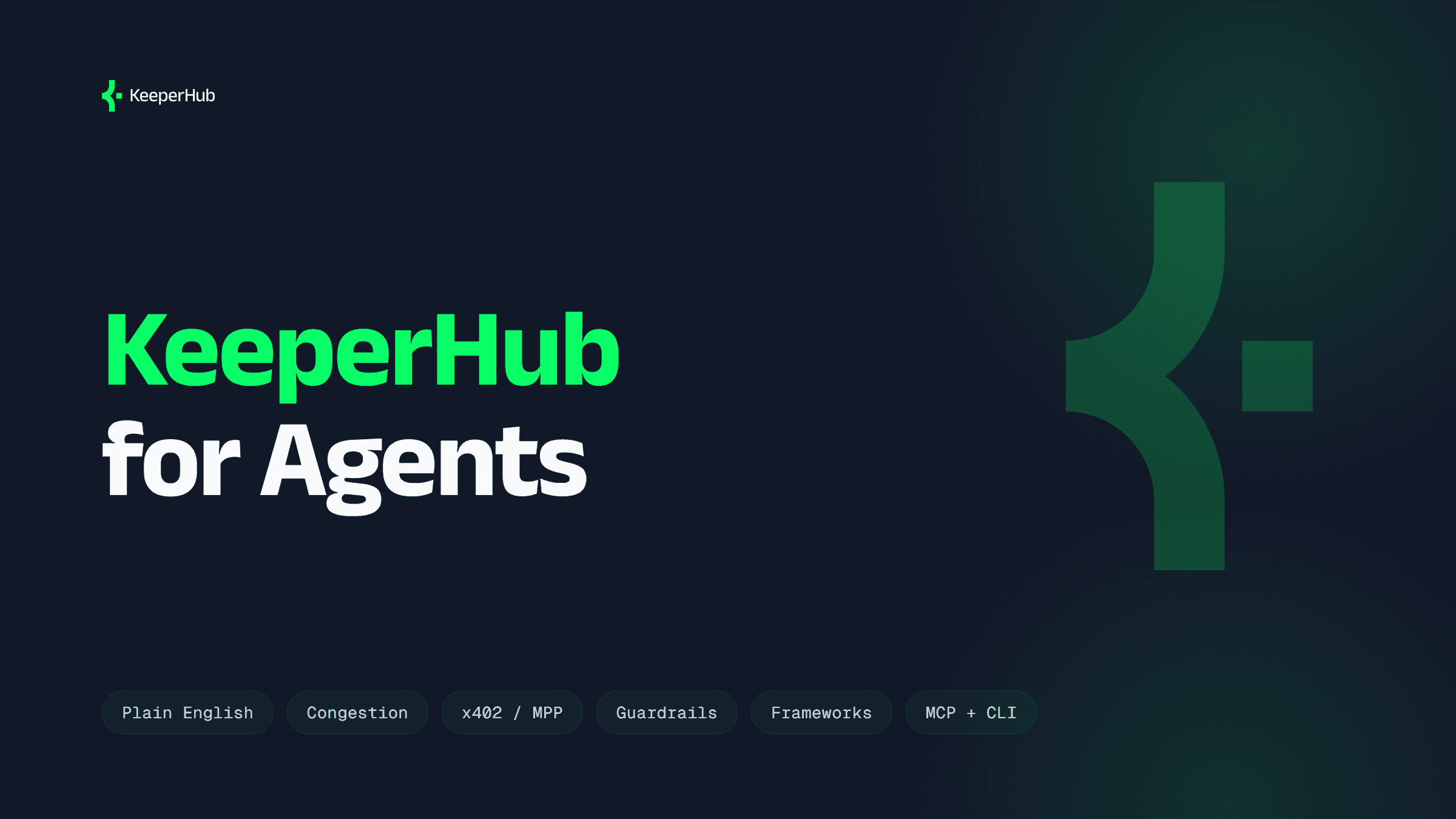
Agents decide, KeeperHub executes. Deterministically, repeatedly, with full control and an auditable record.
Connect over MCP or CLI, describe the workflow in plain English, and KeeperHub builds it, runs it, and shows you exactly what happened.
The agent authors it. KeeperHub runs it.
KeeperHub workflows are created by an agent, not assembled manually by hand. Agents are excellent at open-ended, one-off tasks. They are the wrong tool for actions that must be right every time. Recurring or scheduled transactions must be deterministic, not re-interpreted by the agent on each run, and often need explicit human approval before value moves. The agent authors the workflow once; KeeperHub executes it reliably, on schedule, with guardrails and sign-off where needed, inside policies the model itself cannot change. A saved workflow artifact also stops you burning agent tokens re-creating the same action every run.
Describe it. The agent builds it.
There's no node editor and no ABI calls: you type what you want and the agent turns it into a live workflow.
The actual prompt: "Create a workflow that checks the Ethereum balance of my wallet on Ethereum every hour. And if it drops below 0.5, send me a Telegram alert."
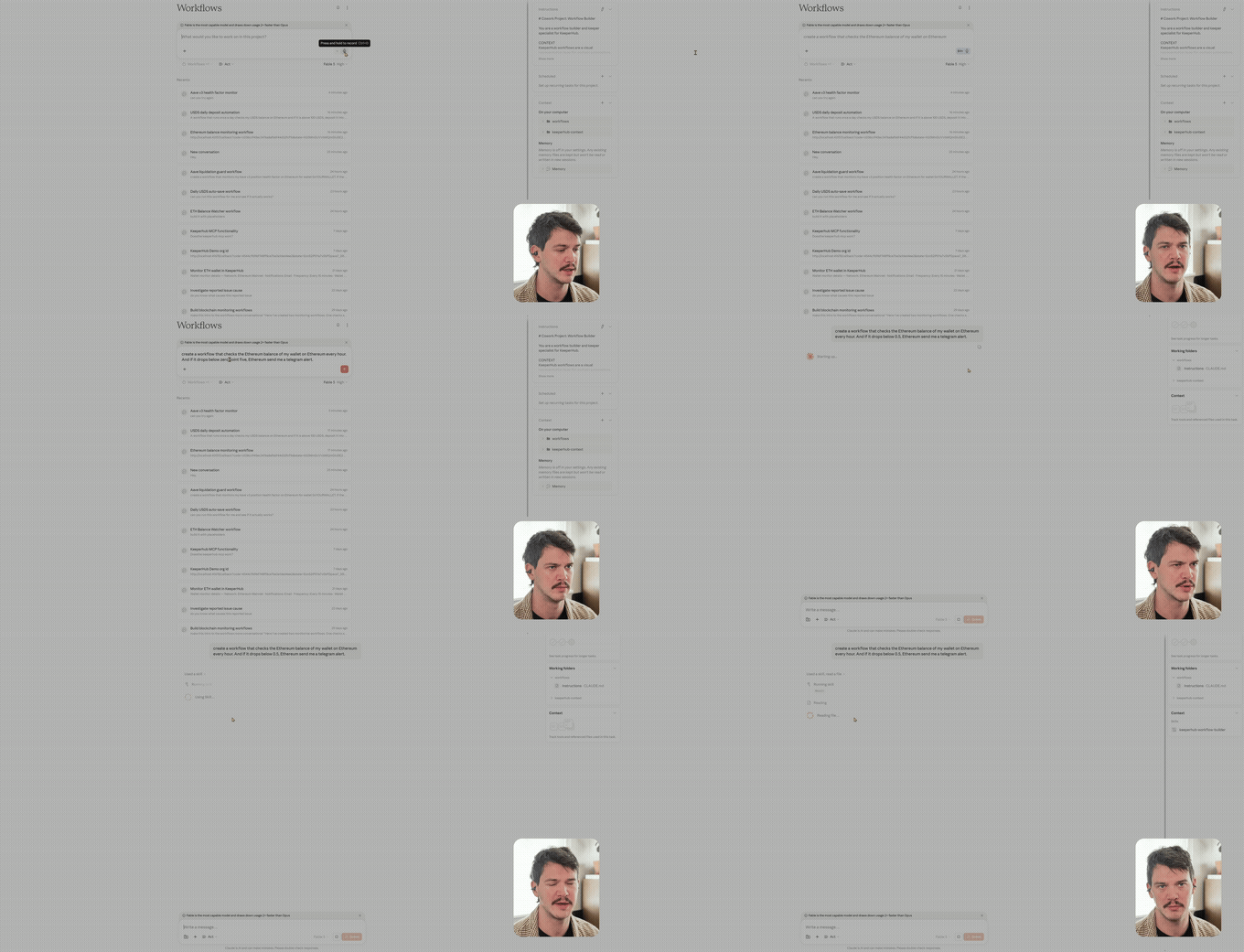
Watch this part of the demo on YouTube: Build DeFi Automations by Describing Them, 4:20
See exactly what got built
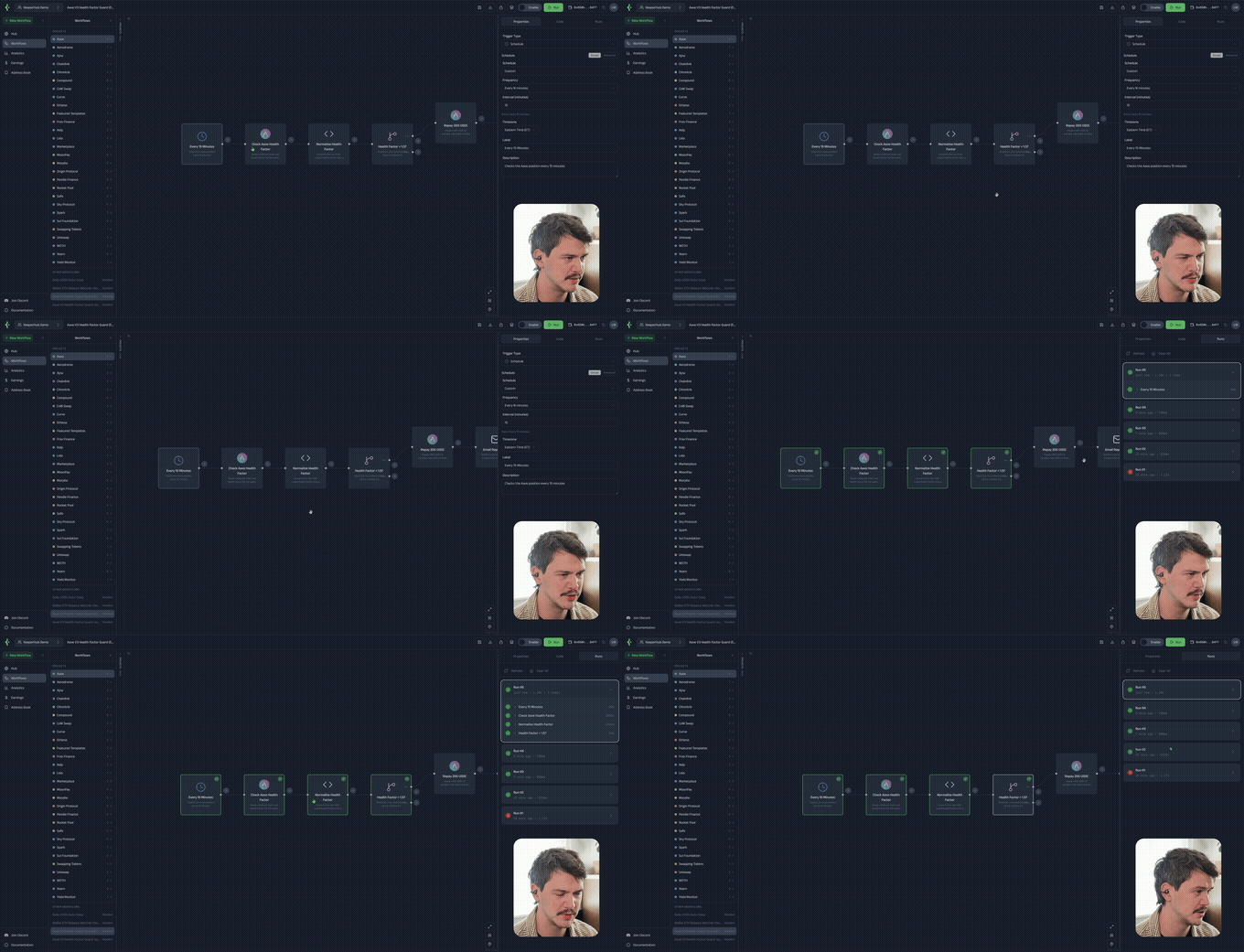
Every workflow opens as a real diagram: trigger, checks, condition, action. Nothing is hidden behind the prompt.
Here's the agent-built result for a different ask, monitoring an Aave v3 health factor and repaying debt if it drops below 1.5: a schedule, a health-factor check, a threshold, and a repay action, with every run logged on the right.
Watch this part of the demo on YouTube: Build DeFi Automations by Describing Them, 9:25
It keeps running under pressure
Gas spikes and network congestion are exactly when hand-rolled bots fail, but KeeperHub retries with exponential backoff, prices each transaction with Smart Gas Estimation, and routes privately to avoid MEV. Your agent gets back a confirmed transaction, not a guess.
It pays for what it runs
KeeperHub is live on both x402 and MPP, so your agent pays per execution, autonomously, with no invoices and no human in the loop. It's indexed on x402scan.com too, so agents can discover and pay for it like any other x402 service.
Agent-native payment rails are showing up across the infrastructure stack now: Coinbase built the x402 protocol, Stripe has it in private preview, Cloudflare is shipping agent wallets on top of it. That's the payment problem slowly but surely getting solved. KeeperHub picks up where the authorization ends: once an agent's payment clears, KeeperHub still has to get the transaction onchain, simulated, priced, and confirmed.
You set the limits
Scoped access: contracts, functions, and conditions are defined up front, so nothing executes outside that scope.
Simulated first: every transaction runs through a simulation before it's submitted.
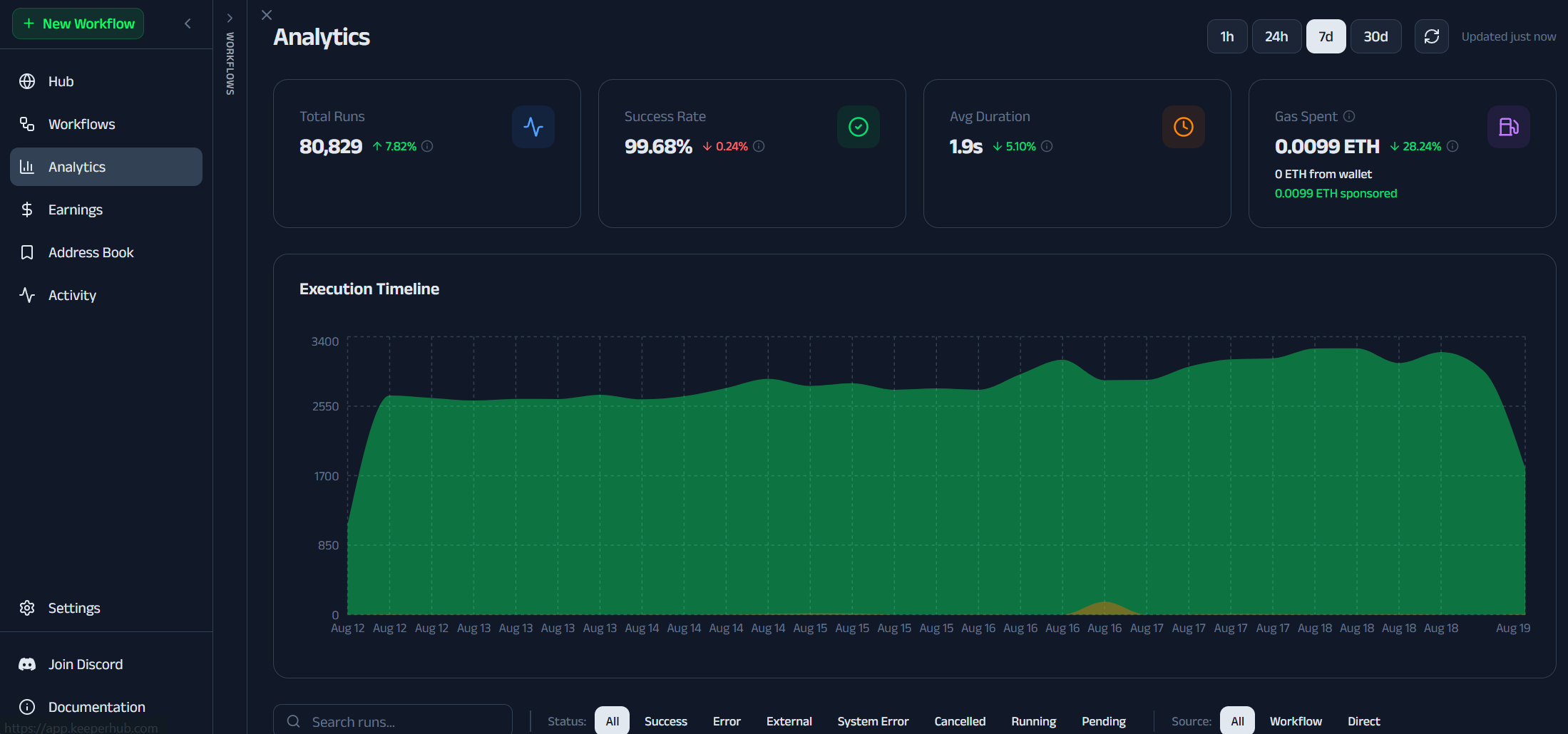
Fully logged: trigger, simulation, transaction, gas, outcome, timestamp, every action is recorded and exportable.
Open source: inspect exactly what your agent is depending on.
A traceable record for every agent
Every agent connected to KeeperHub gets its own record: the workflows it created, the triggers that fired, the transactions it submitted, and the outcome of each one. When multiple agents share infrastructure, that matters: the audit trail answers "which agent did this," not just "what happened." Nothing runs anonymously. Every action traces back to the agent that took it, exportable for review, debugging, or a DAO post-mortem.
Works with your stack
KeeperHub is the execution backend, not a replacement for your orchestration layer. It plugs into LangChain, CrewAI, ElizaOS, Coinbase AgentKit, Almanak, OpenClaw, Hermes, and other agent frameworks. Your framework decides. KeeperHub makes sure it lands, backed by Managed DeFi: 24/7 engineering support with formal SLAs. Integration guides for ElizaOS, Coinbase AgentKit, OpenClaw, and Hermes live on the integrations page; any other framework connects the same way through the KeeperHub MCP server or REST. The agent execution layer has the full picture.