MCP Standardised the Interface. It Didn't Solve Execution.
Your AI agent detects a liquidation opportunity across three lending markets. It calculates the optimal response in milliseconds. It generates a perfectly formed transaction. Then the transaction fails: gas estimation was wrong, the network spiked, a nonce collided, and nobody got alerted.
The intelligence was flawless. The execution wasn't.
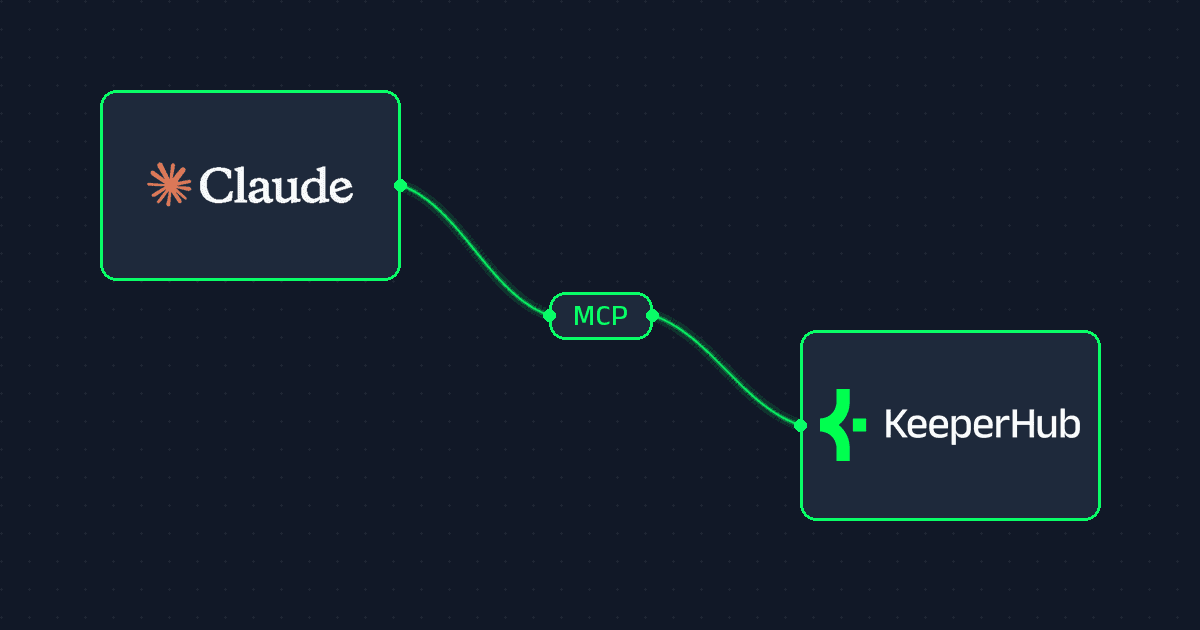
That's the gap KeeperHub closes. With a single MCP server connection, your agent gets access to battle-tested on-chain execution: smart gas estimation, automatic retries, SLA-backed guarantees, and full audit trails. No fragile scripts. No silent 3 a.m. failures.
The Model Context Protocol (MCP) gave AI agents a standard way to reach external tools and services. Hundreds of MCP servers now exist for everything from GitHub to Slack to Postgres. But MCP solved the interface. It didn't solve what happens after the call is made.
On-chain execution is where agent intelligence goes to die. And that's exactly where we've operated for seven years.
This isn't a tooling problem. It's an infrastructure problem.
The scenario above isn't hypothetical. It plays out every day across DeFi. Gas spikes during a liquidation cascade. A nonce collision on a multi-step strategy. A retry loop that dies silently because nobody built monitoring into the bot.
Most teams try to solve this with more code: custom retry logic, gas estimation heuristics, alerting scripts bolted on after the fact. It works until it doesn't. And it always stops working at the exact moment it matters most.
Reliable on-chain execution requires purpose-built infrastructure, not another wrapper around eth_sendTransaction. That's a fundamentally different engineering challenge from building a good AI model or a clean MCP integration.
What KeeperHub brings to the MCP stack
KeeperHub is the Reliable Execution Layer for the on-chain economy. We've been securing billions in TVL. Through Black Thursday, through every network congestion event, through market conditions that killed lesser infrastructure.
We didn't build that track record by being clever. We built it by solving the hard parts of on-chain execution that no one else wanted to own: smart gas estimation, exponential backoff, SLA-backed guarantees, and audit trails that tell you exactly what happened and when.
When MCP became the standard for agent-to-tool communication, our position as the AI agent execution layer became obvious.
Detect threats. Decide with AI. Execute on-chain.
KeeperHub functions as an MCP server. Any AI agent that speaks MCP can route its on-chain actions through KeeperHub's execution infrastructure. Your agent doesn't babysit transactions. It doesn't retry failed calls. It doesn't manage gas, nonces, or private keys.
It issues the instruction. KeeperHub handles the rest.
Add KeeperHub to your MCP setup in two steps
The KeeperHub Claude plugin is live. If you're already running Claude with MCP support, getting KeeperHub into your stack takes under a minute.
1. Install the plugin
/plugin marketplace add techops-services/claude-plugins
/plugin install keeperhub@techops-plugins
2. Run setup
/keeperhub:login
That's it. Once authenticated, you can issue natural-language instructions to manage and trigger your KeeperHub workflows directly from Claude. No context switching, no dashboards.
Try it: "list keeperhub workflows"
What comes next
We're investing heavily in the MCP surface area. That means richer tooling for agent developers, deeper Web3 node coverage, and execution guarantees that match the ambition of the systems being built on top of them.
Common questions
How do AI agents execute transactions on-chain?
An AI agent decides what to do, but it needs an execution layer to do it reliably — gas estimation, retries, nonce management, and monitoring. Agents connect to KeeperHub through a single MCP server connection and get battle-tested on-chain execution with SLA-backed guarantees, instead of hand-rolling transaction plumbing.
What is an MCP server for blockchain automation?
An MCP (Model Context Protocol) server exposes tools that AI agents can discover and call natively. KeeperHub's MCP server exposes workflow creation, triggering, and monitoring as agent tools — so any MCP-compatible agent (Claude, GPT, LangChain, CrewAI) can build and run on-chain automations without custom integration code.
Why do agent transactions fail without an execution layer?
The common failure modes are wrong gas estimation, network fee spikes, nonce collisions, and RPC outages — and without monitoring, nobody is alerted. KeeperHub handles these with smart gas pricing, automatic retries with exponential backoff, and a full audit trail per execution.
If you're building agent pipelines that touch on-chain execution, or you're a protocol team evaluating what happens when AI enters your automation stack, we'd like to talk.
Stop relying on ad-hoc scripts. Upgrade to audited, SLA-backed automation today.
Related: KeeperHub MCP server · The agent execution layer